
Rx10% OFF

₹6931₹7701.56
View DetailsLoading...
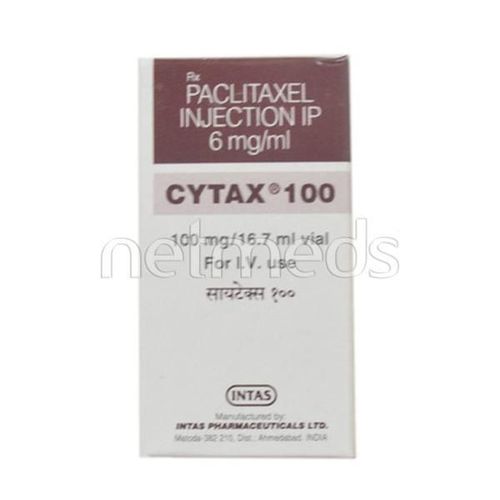
by Naprod Life Sciences Pvt. Ltd.· 16.7ML
SKU: 384881
You save ₹247 on this order
Inclusive of all taxes
CYTAX 100MG INJECTION contains Paclitaxel which belongs to a group of
anti-cancer medicines called Taxanes. CYTAX 100MG INJECTION is used to manage
ovarian and breast cancer as a first line of therapy and as a second line of
management when platinum containing medicines (such as cisplatin) or
anthracyclines are insufficient to manage the disease in affected individuals.
CYTAX 100MG INJECTION is also used to manage advanced NSCLC (non-small cell lung
cancer) when surgery/radiation therapy is not suitable. The medicine is also
indicated for use to manage AIDS-related Kaposi’s sarcoma when other managements
(such as anthracyclines) are insufficient to manage the disease in affected
individuals.
CYTAX 100MG INJECTION is not recommended for use in patients allergic to
paclitaxel and polyoxyethylated castor oil. It is also not recommended for use
in patients with few white blood cells count and serious & uncontrolled
infection. The medicine is also not used in patients suffering from severe liver
disease.
Before receiving CYTAX 100MG INJECTION, inform your doctor if you had previously
received radiation to your chest and/or suffering from thrombocytopenia (low
platelet count)/acute infections (such as herpes zoster, chickenpox, herpes),
kidney problems (such as chronic kidney disease), liver problems (such as
mild/moderate hepatic impairment) and/or heart problems (such as severe coronary
artery disease, myocardial infarction and arrhythmias).
CYTAX 100MG INJECTION is not recommended for use during pregnancy. Women of
child-bearing potential should use effective contrace
receiving CYTAX 100MG INJECTION which should be continued for next-6 months
after completing the management. The medicine is also not recommended for use in
breastfeeding women.
CYTAX 100MG INJECTION is also not recommended for use in children and
adolescents (aged below 18 years). The medicine can be used with caution in
elderly patients (aged above 65 years) after consulting the doctor.
The most common side effects of receiving CYTAX 100MG INJECTION are minor
allergic reactions (such as flushing, rash, itching), shortness of breath, sore
throat/mouth ulcers, diarrhea, nausea, vomiting and/or loss of hair. Consult
your doctor if any of these symptoms worsen.
CYTAX 100MG INJECTION works by interfering with the microtubule structures in
the cell (substance which aids cancer cells to divide and multiply) thus
inhibiting the growth of cancer cells and managing its spread in affected
individuals.
CYTAX 100MG INJECTION will be given to you only by a doctor or a nurse into a
vein as an intravenous infusion. Your doctor will decide the correct dose and
duration for you depending upon your age, body weight and disease condition.
Diarrhea:
Drink plenty of water and stay hydrated. Try to avoid taking any medicine on
your own to manage diarrhea. Consult your doctor and inform them if the symptom
gets worse.
Nausea and vomiting:
Try to receive CYTAX 100MG INJECTION with or just after a meal or a snack. Stick
to simple meals. Avoid eating rich or spicy food. Consult your doctor if symptom
gets worse.
Headache:
If CYTAX 100MG INJECTION causes headache, then take rest and drink plenty of
fluids. Try to avoid drinking alcohol. Ask your doctor to recommend a
painkiller. Headaches should usually go away after the first week of receiving
CYTAX 100MG INJECTION. If it lasts more than a week or severe, inform your
doctor.
Dizziness:
Try to rest and get enough sleep. Try to avoid driving or operating any tools or
machines while you feel dizzy. Limit consum
dizziness. Consult and inform your doctor if the symptom worsens.
Tiredness:
Make sure you take rest and drink plenty of fluids. Avoid or limit the
consum
can sit down (or lie down) when the symptoms are at their worst. Avoid driving
or using tools or machinery until you feel well.
!### Pregnancy
CYTAX 100MG INJECTION is generally not recommended for use in pregnant women.
Women with child-bearing potential should use effective contrace
while receiving CYTAX 100MG INJECTION which should be continued for next-6
months after completing the> management. Consult your doctor before receiving
CYTAX 100MG INJECTION.
!### Breastfeeding
CYTAX 100MG INJECTION is not recommended for use in breastfeeding women as it is
not known whether the medicine pass through breast milk. Consult your doctor
before receiving the medicine.
!### Driving and Using Machines
Do not drive or use heavy machines if you feel dizzy/tired after receiving CYTAX
100MG INJECTION.
!### Alcohol
Avoid consum
cause harmful effects to the patient.
!### Kidney
CYTAX 100MG INJECTION should be used with caution in patient with chronic kidney
disease. Consult your doctor before receiving CYTAX 100MG INJECTION.
!### Liver
CYTAX 100MG INJECTION is not recommended for use in patients with severe hepatic
impairment. It should be used with caution in patients with mild to moderate
hepatic impairment. Consult your doctor before receiving the medicine.
!### Allergy
Do not receive CYTAX 100MG INJECTION if you are allergic to paclitaxel,
polyoxyethylated castor oil and/or any other ingredients of this medicine.
!### Heart Disease
CYTAX 100MG INJECTION should be used with caution in patients with heart
conduction problems, severe coronary artery disease, myocardial infarction and
arrhythmias. Consult your doctor before receiving the medicine.
CYTAX 100MG INJECTION is not recommended for use if you:
Before receiving CYTAX 100MG INJECTION, inform your doctor if you:
Use in Pediatrics:
CYTAX 100MG INJECTION is not recommended for use in children and adolescents
(aged below 18 years). Consult your doctor before receiving the medicine.
Use in Geriatrics:
CYTAX 100MG INJECTION should be used with caution in elderly patients (aged
above 65 years). Consult your doctor before receiving the medicine.
A. Drug - Drug interactions:
Before receiving CYTAX 100MG INJECTION, inform your doctor if you are taking any
of the following medicine:
Overdosage:
CYTAX 100MG INJECTION will be administered to you only by a doctor or a nurse in
a hospital and so it is unlikely to receive an overdose. However, consult your
doctor or nurse if you experience any unusual symptoms.
| Drug | : | Paclitaxel |
| Pharmacological Category | : | Antineoplastic agents |
| Therapeutic Indication | : | Ovarian cancer, Breast cancer, Kaposi sarcoma, Non-small cell lung cancer (NSCLC) |
| Dosage Forms | : | Injection |
What is CYTAX 100MG INJECTION used for?
CYTAX 100MG INJECTION is used to manage ovarian and breast cancer as a first
line of therapy and as a second line of management when platinum containing
medicines (such as cisplatin) or anthracyclines are insufficient to manage the
disease. It is also used to manage advanced NSCLC (non-small cell lung cancer)
and AIDS-related Kaposi’s sarcoma in affected individuals.
How CYTAX 100MG INJECTION works?
CYTAX 100MG INJECTION works by interfering with the microtubule structures in
the cell (substance which aids cancer cells to divide and multiply) thus
inhibiting the growth of cancer cells and managing its spread in affected
individuals.
What are the most common side effects of receiving CYTAX 100MG INJECTION?
The most common side effects of receiving CYTAX 100MG INJECTION are minor
allergic reactions (such as flushing, rash, itching), shortness of breath, sore
throat/mouth ulcers, diarrhea, nausea, vomiting and/or loss of hair. Consult
your doctor if any of these symptoms worsen.
How to administer CYTAX 100MG INJECTION?
CYTAX 100MG INJECTION will be given to you only by a doctor or a nurse into a
vein as an intravenous infusion. Your doctor will decide the correct dose and
duration for you depending upon your age, body weight and disease condition.
Can CYTAX 100MG INJECTION be used in pregnant women?
No, CYTAX 100MG INJECTION is not recommended for use in pregnant women. Women
with child-bearing potential should use effective contrace
receiving CYTAX 100MG INJECTION which should be continued for next-6 months
after completing the management. Consult your doctor before receiving CYTAX
100MG INJECTION.


