
Rx13% OFF

₹98₹112
View DetailsLoading...
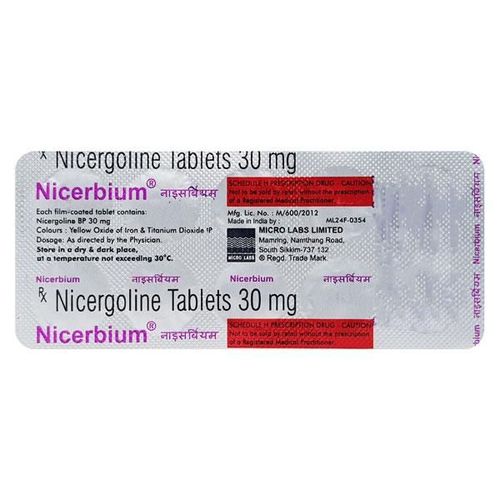
by Micro Labs Ltd· 10S
SKU: 44914
You save ₹80 on this order
Inclusive of all taxes
NICERBIUM 30MG TABLET contain Nicergoline which belongs to a group of medicine
called Nootropic agents. NICERBIUM 30MG TABLET is used to manage cerebrovascular
insufficiency (insufficient blood flow to the brain) and dementia (loss of
cognitive functions) that occurs in old age.
NICERBIUM 30MG TABLET is also used as a peripheral vasodilator to manage
vascular (blood vessel) disorders (such as cerebral thrombosis, atherosclerosis,
diabetic retinopathy, macular degeneration, and retinal Angio sclerosis) in
affected individuals. The medicine is also indicated for use to manage migraine,
and Raynaud’s phenomenon (condition marked by reduced blood flow to the
fingers).
NICERBIUM 30MG TABLET is not recommended for use in patients allergic
(hypersensitive) to Nicergoline. It is also not recommended for use in patients
suffering from acute bleeding, orthostatic dysregulation (impaired regulation of
orthostatic blood pressure). It is also not indicated for use in patients
suffering from heart diseases (such as recent myocardial infarction/severe
bradycardia).
Before taking NICERBIUM 30MG TABLET, inform your doctor if you have high blood
pressure, hyperuricemia (excess uric acid in blood), gout (inflammatory joint),
liver problems, and/or kidney problems (such as impaired renal function).
NICERBIUM 30MG TABLET is not recommended for use during pregnancy and in women
planning for pregnancy. It is also not recommended for use in breastfeeding
women.
NICERBIUM 30MG TABLET is not recommended for use in children and adolescents
(aged below 18 years) and is advised to be used with caution in elderly patients
(aged 65years and above) after consulting the doctor.
The most common side effect associated with the use of NICERBIUM 30MG TABLET is
abdominal discomfort. Consult your doctor if the symptom worsens.
NICERBIUM 30MG TABLET works by inhibiting postsyna
(molecules found on vascular smooth muscle) which results in peripheral
vasodilation (widening of blood vessels) thus improving blood flow to the brain
and managing the occurrence of symptoms associated with cerebrovascular
insufficiency, cognitive & vascular disorders, and dementia in affected
individuals.
Take NICERBIUM 30MG TABLET as advised by your physician. Swallow the medicine
with a glass of water. Do not crush or chew the medicine. Your doctor will
decide the correct dose and duration for you depending upon your age, body
weight, and disease condition.
Dizziness:
Try to rest and get enough sleep. Try to avoid driving or operating any tools or
machines while you feel dizzy. Limit consum
dizziness. Consult and inform your doctor if the symptom worsens.
Headache:
If NICERBIUM 30MG TABLET causes headache, then take rest and drink plenty of
fluids. Try to avoid drinking alcohol. Ask your doctor to recommend a
painkiller. Headaches should usually go away after the first week of taking
NICERBIUM 30MG TABLET. If it lasts more than a week or becomes severe, then
consult and inform your doctor.
Constipation:
Try to eat high-fiber foods such as vegetables, cereals, fresh fruit, and drink
plenty of water. Involve in regular exercise (going for a daily walk or run) and
if this does not help, consult and inform your doctor for receiving alternate
managements for constipation.
Nausea and vomiting:
Take NICERBIUM 30MG TABLET with/just after a meal. Stick to simple meals. Avoid
eating oil rich/spicy foods, sugary snacks and drinks. Avoid drinking too much
liquid along with your meals, and drink slowly in between meals. Consult your
doctor if the condition worsens.
Diarrhea:
Drink plenty of water and stay hydrated. Try to avoid taking any medicine on
your own to manage diarrhea. Consult and inform your doctor if the symptom
worsens.
!### Pregnancy
NICERBIUM 30MG TABLET is not recommended for use during pregnancy and in women
planning for pregnancy. Consult your doctor before taking the medicine.
!### Breastfeeding
NICERBIUM 30MG TABLET is not recommended for use in breastfeeding women. Consult
your doctor before taking the medicine.
!### Driving and Using Machines
Do not drive/operate machines if you feel weak, dizzy, and/or drowsy after
taking NICERBIUM 30MG TABLET.
!### Kidney
NICERBIUM 30MG TABLET should be used with caution in patients with kidney
problems such as impaired renal function. Consult your doctor before taking
NICERBIUM 30MG TABLET.
!### Liver
NICERBIUM 30MG TABLET should be used with caution in patients with liver
problems. Consult your doctor before taking NICERBIUM 30MG TABLET.
!### Allergy
Do not take NICERBIUM 30MG TABLET if you are allergic (hypersensitive) to
Nicergoline, other ergot alkaloids, and/or any other ingredients of this
medicine.
!### Heart Disease
NICERBIUM 30MG TABLET is not recommended for use in patients with heart disease
such as recent myocardial infarction, severe bradycardia. Consult your doctor
before taking NICERBIUM 30MG TABLET.
NICERBIUM 30MG TABLET is not recommended for use if you:
Before taking NICERBIUM 30MG TABLET, inform your doctor if you:
Use in Paediatrics:
NICERBIUM 30MG TABLET is not recommended for use in children and adolescents
(aged below 18 years) due to non-availability of information on safety and
effective use of medicine. Consult your doctor before taking the medicine
Use in Geriatrics:
NICERBIUM 30MG TABLET should be used with caution in elderly patients (aged
65-years and above). Consult your doctor before taking the medicine.
A. Drug-Drug interactions:
Before taking NICERBIUM 30MG TABLET, inform your doctor if you are taking any of
the following medicine:
Overdosage:
If you or anyone else accidentally take too much of NICERBIUM 30MG TABLET,
consult your doctor immediately or visit the nearby hospital. Decrease in blood
pressure/low blood pressure can occur as an overdose symptom in affected
individuals.
| Drug | : | Nicergoline |
| Pharmacological Category | : | Nootropic agents |
| Therapeutic Indication | : | Cerebrovascular insufficiency & dementia, Vascular disorders, Migraine, and Raynaud’s phenomenon |
| Dosage Forms | : | Tablet |
Q. What is NICERBIUM 30MG TABLET used for?
NICERBIUM 30MG TABLET is used in elderly patients to manage cerebrovascular
insufficiency (insufficient blood flow to the brain) and dementia (loss of
cognitive functions) which is also used to manage vascular (blood vessel)
disorders. The medicine is also indicated for use to manage migraine, and
Raynaud’s phenomenon (condition marked by reduced blood flow to the fingers) in
affected individuals.
Q. What are the side effects of NICERBIUM 30MG TABLET?
The most common side effect associated with the use of NICERBIUM 30MG TABLET is
abdominal discomfort. Consult your doctor if the symptoms worsens.
Q. How NICERBIUM 30MG TABLET is taken?
A. Take NICERBIUM 30MG TABLET as advised by your physician. Swallow the medicine
with a glass of water. Do not crush or chew the medicine. Your doctor will
decide the correct dose and duration for you depending upon your age, body
weight, and disease condition.
Q. How NICERBIUM 30MG TABLET works?
A. NICERBIUM 30MG TABLET works by inhibiting postsyna
(molecules found on vascular smooth muscle) which results in peripheral
vasodilation (widening of blood vessels) thus improving blood flow to the brain
and managing the occurrence of symptoms associated with cerebrovascular
insufficiency, cognitive & vascular disorders, and dementia in affected
individuals.
Q. What happens if NICERBIUM 30MG TABLET is taken more than its required
dosage?
A. If you or anyone else accidentally take too much of NICERBIUM 30MG TABLET,
consult your doctor immediately or visit the nearby hospital. Decrease in blood
pressure/low blood pressure can occur as an overdose symptom in affected
individuals.


