
OTC20% OFF

₹116₹145
View DetailsLoading...
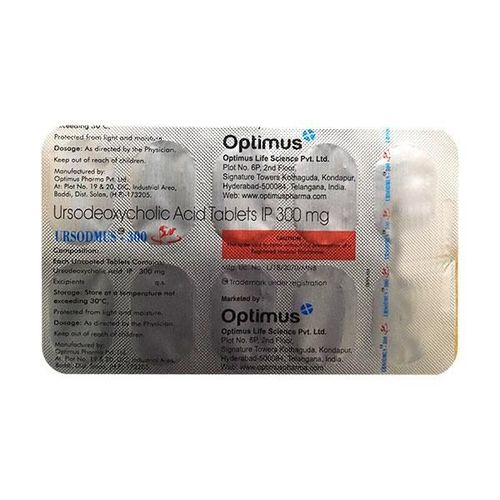
by Optimus Lifescience Pvt Ltd· 10S
SKU: 948930
You save ₹67 on this order
Inclusive of all taxes
URSODMUS 300 TABLET contains Ursodeoxycholic Acid, which is a liver health
supplement. It is used to manage primary biliary cirrhosis (damage of bile ducts
in the liver leading to the buildup of bile).
URSODMUS 300 TABLET is also used to dissolve small gallstones that are not
visible on X-rays (less than 15 mm in diameter) in patients with a functioning
gall bladder. Gall stones are hardened deposits mostly made up of cholesterol
that can form in the gallbladder and can cause sharp, intense pain in the upper
right part of the abdomen.
URSODMUS 300 TABLET can also be used for liver disease associated with cystic
fibrosis in children aged 6 to less than 18 years. Cystic fibrosis is a disease
that affects the cells that produce mucus, sweat, and digestive juices and
causes these fluids to become thick and sticky, resulting in plugged-up tubes,
ducts, and passageways.
During or while the management with URSODMUS 300 TABLET, your doctor might ask
you to get several diagnostic tests done, such as a liver function test and a
gall bladder scan.
URSODMUS 300 TABLET is not recommended for use in patients with allergies to
bile acids, calcified gallstones, inflammation of the gallbladder or the bile
ducts, blockage of the common bile duct or cystic duct, frequent cramp-like
pains in the upper abdomen, low bile flow in children, or improper function of
the gall bladder. URSODMUS 300 TABLET should be used with caution in patients
with liver diseases.
URSODMUS 300 TABLET should be taken during pregnancy only if clearly advised by
the doctor and should be used with caution in breast-feeding women. Ask for your
doctor’s advice before taking. URSODMUS 300 TABLET can be used in children,
adolescents, and the elderly. Your doctor will decide the correct dose and
duration of therapy with URSODMUS 300 TABLET for you.
The most common side effects of taking URSODMUS 300 TABLET are soft, loose
stools or diarrhea. Consult your doctor if the symptoms worsen or don’t improve.
Used to manage:
URSODMUS 300 TABLET supports liver detoxification by increasing the bile flow
through the liver and protects liver cells. URSODMUS 300 TABLET is concentrated
in bile and decreases biliary cholesterol by suppressing the formation of new
cholesterol by inhibiting its intestinal absor
levels lead to gradually solubilization of cholesterol from gallstones,
resulting in their dissolution.
Always use URSODMUS 300 TABLET exactly as prescribed by your doctor. Take this
medicine with or after meals.
For Tablet, Capsule: Swallow the medicine with a glass of water or milk. Do
not crush or chew the medicine.
For Dispersible Tablet: Disperse the medicine in the specified quantity of
water as mentioned in the label. Consume the mixture immediately after
reconstitution.
Your doctor will decide the right dose and duration of Tab UDILIV for you
depending upon your age, body weight and severity of disease condition. Continue
to take Tab UDILIV for the stipulated duration prescribed by your doctor to
achieve better results. If you feel that the effect of Tab UDILIV is too strong
or too weak for you, please talk to your doctor.
Stop taking Tab UDILIV and contact your doctor immediately if you experience any
of the following side effects:
!### Diarrhea
Drink lots of fluids, such as water or fruit juice to keep yourself hydrated. Do
not consume any medicine on your own without consulting your doctor. Ask for
your doctor’s advice if diarrhoea doesn’t improve.
!### PREGNANCY
Consult your doctorURSODMUS 300 TABLET should be used in pregnant women only if considered clearly
necessary by the doctor. If you are pregnant or think you may be pregnant or are
planning to have a baby, ask your doctor for advice before taking URSODMUS 300
TABLET.
!### BREASTFEEDING
Use with CautionURSODMUS 300 TABLET should be used with caution in breastfeeding women as it is
not known if it passes through breast milk. Consult your doctor if you are
breastfeeding or about to start breastfeeding before taking URSODMUS 300 TABLET.
!### DRIVING AND USING MACHINES
SafeURSODMUS 300 TABLET has no or negligible effect on driving or using machine.
!### LIVER
Use with CautionURSODMUS 300 TABLET should be used with caution in patients with liver diseases.
Your doctor might advise you for frequent liver examination and tests during
the> management. Consult your doctor before taking the URSODMUS 300 TABLET.
!### ALLERGY
ContraindicatedDo not take URSODMUS 300 TABLET if you are allergic to allergic to
Ursodeoxycholic Acid or bile acids or any other components of this medicine.
!### USE IN PEDIATRICS
Consult your doctorURSODMUS 300 TABLET is not recommended for use in children with biliary atresia
(blockage in bile duct) and who have poor bile flow, even after surgery. It can
be used in other children. Your doctor will decide the correct dose and duration
of URSODMUS 300 TABLET for your child depending on his weight, age, and diseases
condition. Consult with your child’s doctor before giving it to your child.
!### USE IN GERIATRICS
Consult your doctorURSODMUS 300 TABLET can be used in elderly patients. However, consult with your
doctor before taking URSODMUS 300 TABLET.
URSODMUS 300 TABLET is not recommended for use if you:
A. Drug-Drug interactions:
Before taking URSODMUS 300 TABLET, inform your doctor if you are taking any of
the following medicines:
Overdosage:
If you or anyone else takes too much of URSODMUS 300 TABLET, consult your doctor
immediately or visit the nearby hospital. The symptom of overdosage is diarrhea.
| Drug | : | Ursodeoxycholic Acid |
| Pharmacological Category | : | Cholagogues and Choleretics |
| Therapeutic Indication | : | Biliary cirrhosis, Gallstones, Liver diseases associated with cystic fibrosis |
| Dosage Forms | : | Tablet, Dispersible tablet, Suspension, Syrup |
A: URSODMUS 300 TABLET is a liver care supplement used for liver detoxification
and promotes liver wellness support, liver health restoration, and liver health
enhancement.
A: URSODMUS 300 TABLET is a liver cleanse supplement used in the management of
primary biliary cirrhosis (PBC). It can also be used in the dissolution of
cholesterol gallstones and to manage liver conditions associated with cystic
fibrosis in children aged 6 to 18 years.
A: During or while the management with URSODMUS 300 TABLET, your doctor might
ask you to get several diagnostic tests done, such as a liver function test and
a gall bladder scan.
A: Do not stop taking URSODMUS 300 TABLET unless advised by your doctor. Your
doctor might advise you on how long you should continue to take URSODMUS 300
TABLET. From time to time, you will need to consult your doctor to review your
management and assess your symptoms.
A: Diarrhoea is the most common side effect of URSODMUS 300 TABLET. It may occur
as a result of an overdose as well. If you do suffer from diarrhea, make sure
you drink enough liquids to replace your fluid and electrolyte balance and stay
hydrated. Stop taking URSODMUS 300 TABLET and inform your doctor immediately if
you have persistent diarrhea.
A: Take URSODMUS 300 TABLET with or after meals. For tablet or capsule, swallow
URSODMUS 300 TABLET with a glass of water or milk. Do not crush or chew the
medicine. For the dispersible tablet, disperse URSODMUS 300 TABLET in the
specified quantity of water as mentioned in the label. Consume the mixture
immediately after reconstitution. If you feel that the effect of URSODMUS 300
TABLET is too strong or too weak for you, please talk to your doctor.
A: URSODMUS 300 TABLET targets the liver, where it becomes concentrated in the
bile produced. Consequently, it inhibits the liver's synthesis and release of
cholesterol, resulting in decreased cholesterol levels in the bile.
Additionally, it manages the intestines from absorbing bile salts and
cholesterol. This dual action lowers cholesterol saturation in bile,
facilitating the gradual dissolution of gallstones and reducing their size over
time until they completely dissolve. Moreover, by enhancing bile flow through
the liver, this medication lowers elevated liver enzyme levels, thus
safeguarding liver cells.
A: Your doctor may advise you to take 2 to 3 doses daily, with the last dose
recommended at bedtime. URSODMUS 300 TABLET is best taken with water or milk and
can be consumed with or after meals. The appropriate timing for taking this
medication may vary based on your specific condition. Ideally, the doses should
be spaced at 6-hour intervals, such as at 8 a.m., 2 p.m., and 8 p.m.
A: Weight gain may be associated with the use of URSODMUS 300 TABLET,
particularly when prescribed for liver disease characterized by chronic bile
stasis in the small bile ducts of the liver. In such cases, the normal flow of
bile from the liver to the small intestine is hindered. It's important to note
that the likelihood of weight gain varies among individuals, depending on the
specific disease. If you notice any weight gain, it is advisable to consult your
doctor for guidance.
A: No, URSODMUS 300 TABLET is used for dissolving gallstones and not kidney
stones.
A: Constipation is one of the common side effects of taking this medicine.
However, it is usually short-lived and disappears on its own. If this side
effect does not resolve on its own, consult your doctor.
A: Generally, it is safe to buy URSODMUS 300 TABLET from reputable online
pharmacies like medicalslot in India. medicalslot adheres to strict regulations to
ensure the quality and authenticity of the medications. medicalslot has made buying
online medicines easier for consumers and is one of India's leading online
pharmacies.
KD. Tripathi. Antiemetic, Prokinetic and Digestant drugs. Essentials of
medical pharmacology. Seventh edition. 2013. Page - 671.
Jelena S Rudic, Goran Poropat, Miodrag N Krstic, Goran Bjelakovic, Christian
Gluud, Cochrane Hepato-Biliary Group. Ursodeoxycholic acid for primary biliary
cirrhosis. NIH National Library of Medicine National Centre for Biotechnology
Information. Pubmed Central. December 2012. [Accessed on 10th July
2024]
Keith D. Lindor, Kris V. Kowdley, Velimir A. C. Luketic, M. Edwyn
Harrison, Timothy McCashland, Alex S. Befeler, Denise Harnois, Roberta
Jorgensen, Jan Petz, Jill Keach, Jody Mooney, Carol Sargeant, Julie
Braaten, Tamara Bernard, Debra King, Ellen Miceli, Jeff Schmoll, Tanya
Hoskin, Prabin Thapa, Felicity Enders. High-dose ursodeoxycholic acid for the
treatment of primary sclerosing cholangitis. NIH National Library of Medicine
National Centre for Biotechnology Information. Pubmed Central. September 2009.
[Accessed on 10th July
2024]
Gustav Paumgartner, Ulrich Beuers. Mech
efficacy of ursodeoxycholic acid in cholestatic liver disease. NIH National
Library of Medicine National Centre for Biotechnology Information. .
February 2004. [Accessed on 10th July
2024]
Mitsubishi Tanabe Pharma Corporation. Efficacy and Safety Study of
Ursodeoxycholic Acid to Treat Chronic Hepatitis C. NIH U.S. National Library of
Medicine. . March 2012. [Accessed on 10th July
2024]
Glenmark Pharmaceuticals Europe Limited. Electronic Medicine Compendium
(EMC). [Revised in March 2019] [Accessed on 10th July
2024]
ABC Farmaceutici S.p.A. Health Products Regulatory Authority (HPRA). [Revised
in July 2021] [Accessed 10th July
2024]
Dr. Falk Pharma GmbH. Electronic Medicine Compendium (EMC). [Revised in
November 2014]. [Accessed on 10th July
2024]
Glenmark Pharmaceuticals Europe Limited. Electronic Medicine Compendium
(EMC). [Revised in March 2019]. [Accessed on 10th July
2024]
DM Pharma. Ursodeoxycholic Acid. [Accessed on 10th July
2024]
MIMS. Ursodeoxycholic Acid (Ursodiol). [Accessed on 10th July
2024]
Drug Bank. Ursodeoxycholic Acid (Ursodiol). [Accessed on 10th July
2024]
• Complete Blood Count (CBC)/ Hemogram • Liver Function Test (LFT)
• Bilirubin Profile • Alkaline Phosphatase, Serum • Bilirubin
Direct, Serum • Bilirubin Total, Serum • Proteins, Serum •
Sgot/Ast • Sgpt/Alt


