
OTC13% OFF

₹42₹48.2
View DetailsLoading...
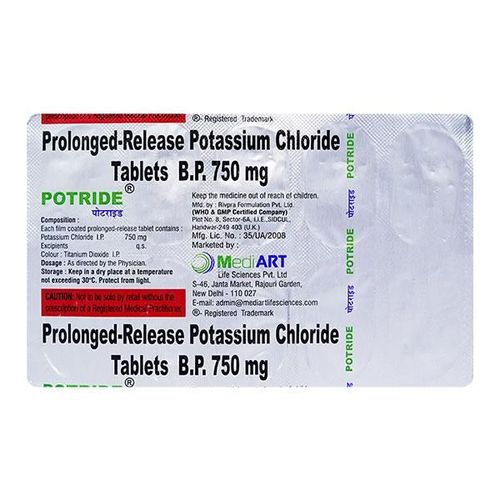
by Mediart Life Sciences Pvt Ltd· 10S
SKU: 992025
You save ₹11 on this order
Inclusive of all taxes
POTRIDE TABLET contains Potassium chloride which belongs to the group of
medicines called Minerals and Electrolytes. It is used to manage hypokalemia
(low blood potassium levels) in patients who have potassium deficiencies and in
patients who take certain medicines that can eliminate potassium from the body
(such as furosemide, hydrochlorothiazide or digitalis etc.).
Always take POTRIDE TABLET with meals. It should not be taken on an empty
stomach as it may lead to gastric irritation. POTRIDE TABLET is used only when
dietary management with potassium-rich foods or diuretic dose reduction is not
effective.
Before taking POTRIDE TABLET, inform your doctor if you have any liver or kidney
problems. You must also inform your doctor before taking POTRIDE TABLET if you
are pregnant or breastfeeding women.
The most common side effects of taking POTRIDE TABLET are nausea, vomiting,
stomach pain, bloating and diarrhea. Consult your doctor if any of the symptom
worsens. You must also inform your doctor if you experience severe vomiting with
stomach pain and bloody stools.
POTRIDE TABLET works by restoring the deficient levels of potassium in the body.
It supplements our body with sufficient potassium which is necessary for proper
functioning of the heart, bones, muscles, kidneys, and nerves. As a result, it
reduces the onset of hypokalemia among patients having potassium deficiency and
in patients taking other medicines that can cause potassium loss in the body
(such as diuretics or digitalis).
Take POTRIDE TABLET as directed by your physician. It should be taken with meals
to avoid gastric irritation. Swallow the medicine with a glass of water. Do not
crush or chew the medicine.
Your doctor will decide the correct dose and duration of the therapy for you
depending up on your age, body weight and disease condition.
Stop taking POTRIDE TABLET and contact your doctor immediately if you experience
any of the following side effects:
Nausea or vomiting:
Take POTRIDE TABLET with or just after meals. Stick to simple meals. Avoid
eating rich or spicy food.
Stomach Pain:
Rest and relax. Eat and drink slowly or try to have smaller and frequent meals.
Take POTRIDE TABLET with meals to avoid unwanted gastrointestinal side effects.
Do not self-manage stomach pain on your own. Consult your doctor if you
experience severe stomach pain with bloody stools.
Diarrhea:
Drink lots of fluids, such as water, electrolytes, or fruit juice to keep
yourself hydrated. Do not take any anti-diarrheal medicines on your own without
consulting your doctor. If you experience diarrhea for a prolonged period,
consult your doctor for advice.
Skin rash:
Avoid hot showers because hot water can irritate your skin further. Do not
scratch the affected area. Use protective clothing while going outdoors.
Regularly moisturize your skin. Consult your doctor if the symptom worsens.
!### Pregnancy
POTRIDE TABLET should be used in pregnant women only if it is considered
necessary by your doctor. Therefore, consult your doctor for advice before
taking it.
!### Breastfeeding
POTRIDE TABLET should be used with caution in breastfeeding women as it may pass
through the breast milk. Therefore, consult your doctor before taking it.
!### Kidney
POTRIDE TABLET should be used with caution in patients with kidney problems.
Therefore, consult your doctor for advice before taking it.
!### Liver
POTRIDE TABLET should be used with caution in patients with liver problems (such
as liver cirrhosis). Therefore, consult your doctor for advice before taking it.
!### Allergy
Do not take POTRIDE TABLET if you are allergic to Potassium chloride.
POTRIDE TABLET is not recommended for use if you:
Before taking POTRIDE TABLET, inform your physician if you:
Use in pediatrics:
There is no proper information regarding the use of POTRIDE TABLET in children
and adolescents (below 18 years). Therefore, consult your doctor for advice
before taking it.
Use in geriatrics:
POTRIDE TABLET should be used with caution in the elderly patients (65 years or
older). Therefore, consult your doctor for advice before taking it.
A. Drug-Drug interactions:
Before taking POTRIDE TABLET, inform your doctor if you are taking any of the
following medicines such as:
Overdosage:
If you or anyone else accidentally took more POTRIDE TABLET, contact your doctor
immediately or visit the nearby hospital straight away. Symptoms of overdose
might include prolong QT interval, abnormal heart rhythm and cardiac arrest.
| Drug | : | Potassium chloride |
| Pharmacological Category | : | Electrolytes |
| Therapeutic Indication | : | Hypokalemia |
| Dosage Forms | : | Tablet, injection, liquid, syrup |
Can POTRIDE TABLET be used to manage diarrhea?
No. POTRIDE TABLET is a potassium salt used to manage potassium deficiency. It
can manage or manage hypokalemia in patients who have potassium deficiencies and
in patients who take certain medicines which can eliminate potassium from the
body (such as furosemide, hydrochlorothiazide, or digitalis etc.). It is not
recommended for use in diarrhea or in other dehydration states. However, consult
your doctor for advice before taking.
Can POTRIDE TABLET be used in children?
There is no proper information regarding the use of POTRIDE TABLET in children
and adolescents (below 18 years). Therefore, consult your doctor for advice
before taking it.
Is POTRIDE TABLET safe for use in patients with diabetes?
POTRIDE TABLET should be used with caution if you are diabetic or have diabetic
ketoacidosis. Your doctor may also advise regular monitoring of your blood sugar
level during the management. Consult your doctor for advice.
Is POTRIDE TABLET safe for use in patients with impaired kidney function?
POTRIDE TABLET should be used with caution in patients with kidney diseases. It
is also important to inform your doctor about all the others medicines you take
which can affect your kidneys like spironolactone, triamterene or amiloride
How long should I take POTRIDE TABLET?
POTRIDE TABLET should be used as recommended by your doctor. Your doctor will
decide the correct dose and duration of the therapy depending upon your age,
body weight and severity of your disease condition. Do not stop taking POTRIDE
TABLET without consulting your doctor.
Can I stop taking POTRIDE TABLET if my symptoms subside?
Though the symptoms of your disease subside, do not stop taking POTRIDE TABLET
unless recommended by your doctor as the disease and its symptoms may worsen
back again. Consult your doctor for advice.
What happens when you forget to take POTRIDE TABLET?
If you forget to take a dose of POTRIDE TABLET on time, take it as soon as you
remember. However, skip the missing dose if it is time for the next dose., Do
not take a double dose to make up for a missed dose.
Can POTRIDE TABLET cause bleeding in the rectum?
Yes. POTRIDE TABLET may cause severe vomiting with stomach pain and bleeding
from the rectum (bloody stools). If you experience such symptoms, stop taking
this medicine and consult your doctor immediately as it could be a sign of
severe ulceration or block in the gastrointestinal tract.
Can I take POTRIDE TABLET as a management measure even if my potassium level
is normal?
No. POTRIDE TABLET is not recommended for use in healthy people as a supplement.
It is a potassium salt used in patients who have potassium deficiencies and in
patients who take certain medicines which can eliminate potassium from the body
only when dietary management with potassium-rich foods or diuretic dose
reduction is not effective.


