
Rx20% OFF

₹59₹74.07
View DetailsLoading...
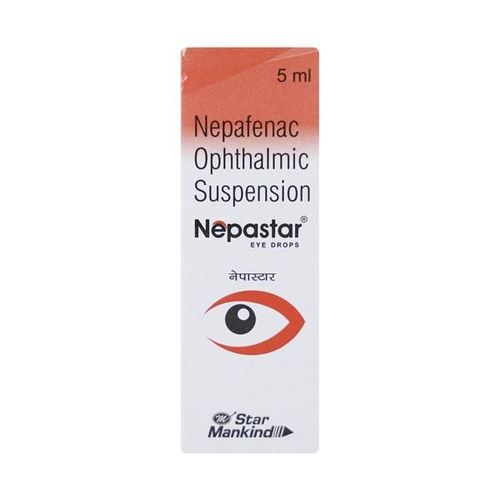
by Akums Drugs & Pharmaceuticals Ltd· 5ML
SKU: 360160
You save ₹43 on this order
Inclusive of all taxes
NEPASTAR contains Nepafenac which belongs to the group of medicines called
Ophthalmic anti-inflammatory agents. It is used in adults to manage eye pain and
eye inflammation following cataract surgery. It can also be used to manage the
risk of macular edema (swelling at the back of the eye) following cataract
surgery in diabetic patients.
NEPASTAR is for ophthalmic use only. Use NEPASTAR as instructed by the physician
to achieve better results. Avoid wearing contact lenses after undergoing
cataract surgery. Your doctor will advise you when you can use contact lenses
again.
Before using NEPASTAR inform your doctor if you have diabetes, arthritis or
bleeding problems. You must also inform your doctor if you have any other eye
problems apart from inflammation (such as eye infections, glaucoma etc.).
NEPASTAR is not recommended for use in pregnant women unless considered
necessary by the physician. Women of child-bearing potential must use a suitable
contrace
NEPASTAR can be used in breastfeeding women if prescribed by the doctor. The
most common side effects of using NEPASTAR are visual disturbances, sensation of
a foreign body in the eye and eye irritation. Contact your doctor if they
trouble you.
It is used in adults to:
NEPASTAR is an analgesic medication. It works by blocking the release of certain
chemical messengers (prostaglandins) in the eye that causes inflammation, pain
and swelling. As a result, it provides relief from post-surgical eye pain,
inflammation and swelling.
Use NEPASTAR as advised by your physician. It is for ophthalmic use only.
Wash your hands before application. Tilt your head slightly backwards and place
the tip of the container close to your eyes. Gently pull your lower eyelid and
instill few drops of the medicine as directed by your physician.
Close your eyes and gently press the inner corner of your eye for 2 minutes.
Repeat the same for the other eye if required.
Do not touch the tip of the container with your eyes, eyelids or areas around
your eyes or fingers, to avoid contamination.
Your doctor will decide the correct dose and duration of therapy for you
depending upon your age, body weight and health condition.
Stop using NEPASTAR and contact your doctor immediately if you experience any of
the following side effects:
Eye discomfort:
Wash your eyes with plain cold water. Place an ice pack on your eye to ease the
irritation. Avoid straining your eyes by looking at mobile phones, laptops, or
television. Wear protective eyeglasses while going outdoors. If irritation still
persists, contact your doctor.
Visual Disturbances:
Close your eyes and relax. Do not strain your eyes by looking at mobile phones,
laptops, or television. Avoid driving or operating any heavy tools or machines
while your vision is blur. Consult your doctor if you experience problems in
your vision for a prolonged period.
!### Pregnancy
NEPASTAR is not recommended for use in pregnant women unless considered
necessary by the physician. Therefore, inform your doctor before using NEPASTAR
if you are pregnant, think you may be pregnant or planning to have a baby. Women
of child-bearing potential must use a suitable contrace
pregnancy while undergoing therapy with NEPASTAR.
!### Breastfeeding
NEPASTAR can be used in breastfeeding women if prescribed by the doctor. Consult
your doctor for advice.
!### Driving and Using Machines
Do not drive or operate any machines if you experience blurred vision after
using NEPASTAR. Wait, until your vision becomes clear.
!### Allergy
Do not use NEPASTAR if you are allergic to nepafenac or to other non-steroidal
anti-inflammatory medicines (such as ibuprofen, aspirin, piroxicam, ketoprofen,
diclofenac).
!### Lungs
NEPASTAR is not recommended for use in patients who previously developed asthma
while using any non-steroidal anti-inflammatory drugs. Therefore, consult your
doctor before application.
NEPASTAR is not recommended for use if you:
Before using NEPASTAR, inform your doctor if you:
Use in pediatrics:
NEPASTAR is generally not recommended for use in children and adolescents (aged
below 18 years). Therefore, consult your doctor before application.
Use in geriatrics:
NEPASTAR should be used with caution in elderly patients (aged 65 years and
above). Therefore, consult your doctor before application.
A. Drug-Drug interactions:
Before using NEPASTAR, inform your doctor if you are taking any of the following
medicines such as:
Overdosage:
If you or anyone else accidentally used more NEPASTAR, rinse your eye with warm
water. If still irritation persists, consult your doctor.
| Drug | : | Nepafenac |
| Pharmacological Category | : | Nonsteroidal anti-inflammatory drugs (NSAIDs) |
| Therapeutic Indication | : | Post-operative eye pain, inflammation and swelling |
| Dosage Forms | : | Eye drops, Ophthalmic suspension |
Is it safe to use NEPASTAR in infants?
NEPASTAR is generally not recommended for use in children and adolescents (under
18 years of age). Consult your doctor before taking it.
Is NEPASTAR NSAIDs?
Yes NEPASTAR is a nonsteroidal anti-inflammatory drug (NSAID). It reduces pain
and inflammation in the eyes. It is used to reduce pain and swelling after
cataract surgery.
Can NEPASTAR be used in breastfeeding women?
NEPASTAR should be used with caution in breastfeeding women as it may pass
through the breast milk. Consult your doctor before taking it.
What is the use of NEPASTAR?
NEPASTAR is used to manage and relieve eye pain and inflammation and to reduce
the risk of macular edema (swelling in the back of the eye) following cataract
surgery on the eye in diabetic patients.
Is NEPASTAR causing blurred vision?
Yes. NEPASTAR causes vision to be blurred for a time just after using it. Do not
drive or use a machine until your vision is clear.
Can I use NEPASTAR, if I have asthma?
NEPASTAR is not recommended for use in patients with asthma. Consult your doctor
before using.
How do NEPASTAR work?
NEPASTAR is a non-steroidal anti-inflammatory drug (NSAID) that works by
blocking the release of certain chemical messengers that cause pain and
inflammation (redness and swelling) in the eye.
Can the use of NEPASTAR cause blurred vision?
Yes. NEPASTAR may cause visual disturbances after application in some
individuals, although not everybody gets the,. If your vision becomes blur,
close your eyes for some time and rest. Do not strain your eyes by looking at
mobile phones, laptops, or television. Avoid driving or operating any heavy
tools or machines while your vision is blur. Consult your doctor if you
experience blurred vision for a prolonged period.
Can I use other eye medicines while using NEPASTAR?
Avoid concomittant use of any eye medicines while using NEPASTAR without
consulting your doctor.
How to use NEPASTAR?
Use NEPASTAR as advised by your physician. It is for ophthalmic use only.
Instill few drops of the medicine into the affected eye(s). Close your eyes and
press the corner of your eye with your finger for a minute. Repeat the same for
the other eye if required.
What is the use of NEPASTAR?
NEPASTAR is a prescri
following cataract surgery. It can also be used to manage the risk of macular
edema (swelling at the back of the eye) following cataract surgery in diabetic
patients.
How long does it take for [GBNKRYWORD] to work?
It may take around 10-15 minutes for NEPASTAR to start showing its effects.
However, this period may vary from person-to-person depending upon the dose that
is administered.
What are the side effects of NEPASTAR?
NEPASTAR is generally safe and well tolerated. It may cause visual disturbances,
eye discomfort, sensation of a foreign body in the eye and eye irritation in
some individuals. Contact your doctor if they trouble you.
Can I use NEPASTAR while wearing contact lenses?
No. Avoid wearing contact lenses after cataract surgery. Your doctor will decide
when you should wear contact lenses once again.
Can I stop using NEPASTAR without consulting my doctor?
Do not stop using NEPASTAR without consulting your doctor, as the symptoms may
reappear once again. If you think that you are feeling better or if you wish to
stop using NEPASTAR, contact your doctor for advice.
Can I drive or ride a bike after using NEPASTAR?
Do not drive if you experience blurred vision after using NEPASTAR.
What if I miss a dose of NEPASTAR?
If you missed a dose of NEPASTAR, apply it as soon as you remember. However, if
it is time for next dose, skip the missed dose and use the regular dose. Do not
use a double dose of NEPASTAR to compensate the missed dose.
How NEPASTAR works?
NEPASTAR is an analgesic medication. It works by blocking the release of certain
chemical messengers (prostaglandins) in the eye that causes inflammation, pain
and swelling. As a result, it provides relief from post-surgical eye pain,
inflammation and swelling.


