
Rx11% OFF

₹50₹56
View DetailsLoading...
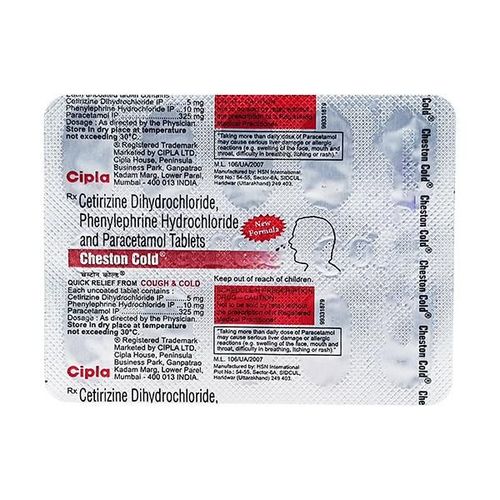
by HSN International· 10S
SKU: 303853
You save ₹5 on this order
Inclusive of all taxes
CHESTON COLD TABLET is a combination of Cetirizine, Paracetamol, and
Phenylephrine, which belong to the group of medicines called Antihistamines,
Analgesic and Antipyretics, and Nasal Decongestants, respectively. CHESTON COLD
TABLET is used to relieve symptoms of common cold, such as a blocked nose, runny
nose, watery eyes, sneezing, congestion or stuffiness, fever, and headache. It
reduces congestion and helps with easy breathing.
Avoid alcohol consum
excessive drowsiness. CHESTON COLD TABLET is not recommended for use in patients
with severe hypertension, coronary artery disease, or liver dysfunction. CHESTON
COLD TABLET should be used with caution in patients with occlusive vascular
disease, including Raynaud’s phenomenon, liver problems, and kidney problems.
CHESTON COLD TABLET should be used with caution in pregnant women, and it is not
recommended for use in breastfeeding women. CHESTON COLD TABLET is not
recommended for use in children and adolescents below 12 years of age. Consult
your doctor before taking the medicine. The most common side effects of CHESTON
COLD TABLET are nausea, vomiting, fatigue, dry mouth, headache, abdominal pain,
drowsiness, and dizziness. Consult your doctor for advice if any of the above
side effects worsen or persist for a longer duration.
It is used to relieve:
CHESTON COLD TABLET is a combination of Cetirizine, Paracetamol, and
Phenylephrine. Cetirizine is an H1 receptor antagonist that works by blocking
the action of a chemical messenger (histamine) responsible for runny noses,
watery eyes, and sneezing. Paracetamol is an analgesic and antipyretic that acts
by inhibiting the synthesis of prostaglandins (chemicals that cause
inflammation, pain, and fever), which helps in reducing pain and fever.
Phenylephrine is a nasal decongestant that acts by narrowing the small blood
vessels, providing temporary relief from congestion or stuffiness in the nose.
Take CHESTON COLD TABLET as advised by your physician. Swallow the medicine with
a glass of water. Do not crush or chew this medicine. The dose and duration for
you will be decided by your physician depending on your age, body weight, and
disease condition.
Stop taking CHESTON COLD TABLET and contact your physician immediately if you
experience the following side effects:
!### Diarrhea
Drink lots of fluids, such as water or fruit juice to keep yourself hydrated. Do
not consume any medicine on your own without consulting your doctor.
!### Dizziness Or Drowsiness
Try to rest and relax. Get enough sleep. Avoid driving or operating any tools or
machines while you are feeling drowsy. Do not drink alcohol, as it can worsen
your drowsiness. Consult your doctor if the symptom did not improve.
!### Nausea And Vomiting
Drink clear or ice-cold drinks. Eat light, bland foods. Avoid fried, greasy, or
sweet foods. Eat slowly and smaller and more frequent meals, drink gradually
larger amounts of clear liquids, avoid solid food until the vomiting episode has
passed, and take rest. If the symptom does not improve, contact your doctor.
!### Stomach Pain
Try to rest and relax. Eat and drink slowly or try to have smaller and more
frequent meals. Keep a heating pad on your stomach. If the symptom does not
improve, contact your doctor.
!### Pregnancy
Monitoring requiredCHESTON COLD TABLET should be used in pregnancy only if the potential benefit
justifies the potential risk to the fetus. Consult your doctor before taking it.
!### Breastfeeding
ContraindicatedCHESTON COLD TABLET is not recommended for use in breastfeeding women. Consult
your doctor before taking it.
!### Driving and Using Machines
Use with CautionDo not drive or operate any machines if you feel sleepy or drowsy after taking
CHESTON COLD TABLET.
!### Alcohol
Consult your doctorAvoid alcohol consum
excessive drowsiness.
!### Kidney
Use with CautionCHESTON COLD TABLET should be used with caution in patients with kidney
problems. Consult your doctor before taking it.
!### Liver
Consult your doctorCHESTON COLD TABLET is not recommended in patients with severe hepatic
dysfunction. It should be used with caution in patients with mild to moderate
liver problems. Consult your doctor before taking it.
!### Allergy
ContraindicatedDo not take CHESTON COLD TABLET if you are allergic to Cetirizine, Paracetamol,
and Phenylephrine, or to any other ingredients of this medicine.
!### Heart Disease
ContraindicatedCHESTON COLD TABLET is not recommended to use in patients with coronary artery
disease and severe hypertension. Consult your doctor before taking it.
!### Use In Pediatrics
ContraindicatedCHESTON COLD TABLET is not recommended for use in children and adolescents below
12 years of age. Consult your healthcare professionals before giving it to your
child.
!### Use In Geriatrics
Use with CautionCHESTON COLD TABLET should be used with caution in elderly patients. Consult
your doctor before taking.
Before taking CHESTON COLD TABLET, inform your doctor if you have:
A. Drug-Drug interactions:
Before taking CHESTON COLD TABLET, inform your doctor if you are taking any of
the following medicines:
Overdosage:
If you or anyone else accidentally takes too much of CHESTON COLD TABLET,
consult your doctor immediately or visit the nearby hospital. Symptoms of
overdosage are restlessness, irritability, palpitations, hypertension,
difficulty in micturition, nausea, vomiting, thirst, convulsions, and liver
damage.
| Drug | : | Cetirizine, Paracetamol, Phenylephrine |
| Pharmacological Category | : | Anti-allergic, Analgesic, Antipyretic, Nasal Decongestants |
| Therapeutic Indication | : | Relieves common cold symptoms |
| Dosage Forms | : | Tablet, Syrup, Suspension, Drops |
A: Cheston Cold Tablet is used to relieve symptoms of common cold, such as a
blocked nose, runny nose, watery eyes, sneezing, congestion or stuffiness,
fever, and headache. It reduces congestion and helps with easy breathing.
A: Yes, the most common side effect of Cheston Cold Tablet is drowsiness.
Caution should be exercised while driving or operating heavy machines. Do not
drive or handle heavy machines if you experience side effects like dizziness or
drowsiness while taking Cheston Cold Tablet. Consult your healthcare
professional if the symptom does not improve.
A: No, it is not advisable to drink alcohol while taking Cheston Cold Tablet.
Consuming alcohol along with Cheston Cold Tablet may aggravate the symptoms of
Cheston Cold Tablet and cause severe liver damage, dizziness, and drowsiness.
Consult your doctor before using it.
A: Cheston Cold Tablet should be used with caution in pregnant women, and it is
not recommended for use in breastfeeding women. Consult your doctor before using
it.
A: No, Cheston Cold Tablet is not an antibiotic. Cheston Cold Tablet is a
combination of cetirizine, paracetamol, and phenylephrine, which belong to the
group of medicines called anti-allergic, analgesic, antipyretic, and
decongestant, respectively. It is used to relieve symptoms of the common cold,
such as a blocked nose, runny nose, fever, headache, watery eyes and sneezing,
allergic rhinitis, and nasal congestion. It does not manage bacterial
infections.
A: Before taking Cheston Cold Tablet, inform your doctor if you have diabetes,
thyroid problems, fits, orocclusive vascular disease (Raynaud’s phenomenon).
A: If you forget to take a dose of Cheston Cold Tablet, take it as soon as you
remember. However, if it is time for the next scheduled dose, skip the missed
dose and take the usual prescribed dose. Do not take a double dose for the
missed dose.
A: Do not stop taking Cheston Cold Tablet, even though you feel better. Your
symptoms may reoccur if you stop taking Cheston Cold Tablet. Inform your doctor
before stopping it.
A: Yes, Cheston Cold Tablet can cause diarrhea in some individuals. Drink lots
of fluids, such as water or fruit juice, to keep yourself hydrated. Do not
consume any medicine on your own without consulting your doctor.
A: Cheston Cold Tablet should be used with caution in patients with kidney
problems. Consult your doctor before taking it.
A: Cheston Cold Tablet is not recommended in patients with severe hepatic
dysfunction. It should be used with caution in patients with mild to moderate
liver problems. Consult your doctor before taking it.
A: The most common side effects of taking Cheston Cold Tablet are nausea,
vomiting, fatigue, dry mouth, headache, abdominal pain, drowsiness, dizziness,
and diarrhea. Consult your doctor if any of the side effects worsen.
CHESTON COLD TABLET is a combination of Cetirizine, Paracetamol, and
Phenylephrine, which belong to the group of medicines called Antihistamines,
Analgesic and Antipyretics, and Nasal Decongestants, respectively. CHESTON COLD
TABLET is used to relieve symptoms of common cold, such as a blocked nose, runny
nose, watery eyes, sneezing, congestion or stuffiness, fever, and headache. It
reduces congestion and helps with easy breathing.
Avoid alcohol consum
excessive drowsiness. CHESTON COLD TABLET is not recommended for use in patients
with severe hypertension, coronary artery disease, or liver dysfunction. CHESTON
COLD TABLET should be used with caution in patients with occlusive vascular
disease, including Raynaud’s phenomenon, liver problems, and kidney problems.
CHESTON COLD TABLET should be used with caution in pregnant women, and it is not
recommended for use in breastfeeding women. CHESTON COLD TABLET is not
recommended for use in children and adolescents below 12 years of age. Consult
your doctor before taking the medicine. The most common side effects of CHESTON
COLD TABLET are nausea, vomiting, fatigue, dry mouth, headache, abdominal pain,
drowsiness, and dizziness. Consult your doctor for advice if any of the above
side effects worsen or persist for a longer duration.
It is used to relieve:
CHESTON COLD TABLET is a combination of Cetirizine, Paracetamol, and
Phenylephrine. Cetirizine is an H1 receptor antagonist that works by blocking
the action of a chemical messenger (histamine) responsible for runny noses,
watery eyes, and sneezing. Paracetamol is an analgesic and antipyretic that acts
by inhibiting the synthesis of prostaglandins (chemicals that cause
inflammation, pain, and fever), which helps in reducing pain and fever.
Phenylephrine is a nasal decongestant that acts by narrowing the small blood
vessels, providing temporary relief from congestion or stuffiness in the nose.
Take CHESTON COLD TABLET as advised by your physician. Swallow the medicine with
a glass of water. Do not crush or chew this medicine. The dose and duration for
you will be decided by your physician depending on your age, body weight, and
disease condition.
Stop taking CHESTON COLD TABLET and contact your physician immediately if you
experience the following side effects:
!### Diarrhea
Drink lots of fluids, such as water or fruit juice to keep yourself hydrated. Do
not consume any medicine on your own without consulting your doctor.
!### Dizziness Or Drowsiness
Try to rest and relax. Get enough sleep. Avoid driving or operating any tools or
machines while you are feeling drowsy. Do not drink alcohol, as it can worsen
your drowsiness. Consult your doctor if the symptom did not improve.
!### Nausea And Vomiting
Drink clear or ice-cold drinks. Eat light, bland foods. Avoid fried, greasy, or
sweet foods. Eat slowly and smaller and more frequent meals, drink gradually
larger amounts of clear liquids, avoid solid food until the vomiting episode has
passed, and take rest. If the symptom does not improve, contact your doctor.
!### Stomach Pain
Try to rest and relax. Eat and drink slowly or try to have smaller and more
frequent meals. Keep a heating pad on your stomach. If the symptom does not
improve, contact your doctor.
!### Pregnancy
Monitoring requiredCHESTON COLD TABLET should be used in pregnancy only if the potential benefit
justifies the potential risk to the fetus. Consult your doctor before taking it.
!### Breastfeeding
ContraindicatedCHESTON COLD TABLET is not recommended for use in breastfeeding women. Consult
your doctor before taking it.
!### Driving and Using Machines
Use with CautionDo not drive or operate any machines if you feel sleepy or drowsy after taking
CHESTON COLD TABLET.
!### Alcohol
Consult your doctorAvoid alcohol consum
excessive drowsiness.
!### Kidney
Use with CautionCHESTON COLD TABLET should be used with caution in patients with kidney
problems. Consult your doctor before taking it.
!### Liver
Consult your doctorCHESTON COLD TABLET is not recommended in patients with severe hepatic
dysfunction. It should be used with caution in patients with mild to moderate
liver problems. Consult your doctor before taking it.
!### Allergy
ContraindicatedDo not take CHESTON COLD TABLET if you are allergic to Cetirizine, Paracetamol,
and Phenylephrine, or to any other ingredients of this medicine.
!### Heart Disease
ContraindicatedCHESTON COLD TABLET is not recommended to use in patients with coronary artery
disease and severe hypertension. Consult your doctor before taking it.
!### Use In Pediatrics
ContraindicatedCHESTON COLD TABLET is not recommended for use in children and adolescents below
12 years of age. Consult your healthcare professionals before giving it to your
child.
!### Use In Geriatrics
Use with CautionCHESTON COLD TABLET should be used with caution in elderly patients. Consult
your doctor before taking.
Before taking CHESTON COLD TABLET, inform your doctor if you have:
A. Drug-Drug interactions:
Before taking CHESTON COLD TABLET, inform your doctor if you are taking any of
the following medicines:
Overdosage:
If you or anyone else accidentally takes too much of CHESTON COLD TABLET,
consult your doctor immediately or visit the nearby hospital. Symptoms of
overdosage are restlessness, irritability, palpitations, hypertension,
difficulty in micturition, nausea, vomiting, thirst, convulsions, and liver
damage.
| Drug | : | Cetirizine, Paracetamol, Phenylephrine |
| Pharmacological Category | : | Anti-allergic, Analgesic, Antipyretic, Nasal Decongestants |
| Therapeutic Indication | : | Relieves common cold symptoms |
| Dosage Forms | : | Tablet, Syrup, Suspension, Drops |
A: Cheston Cold Tablet is used to relieve symptoms of common cold, such as a
blocked nose, runny nose, watery eyes, sneezing, congestion or stuffiness,
fever, and headache. It reduces congestion and helps with easy breathing.
A: Yes, the most common side effect of Cheston Cold Tablet is drowsiness.
Caution should be exercised while driving or operating heavy machines. Do not
drive or handle heavy machines if you experience side effects like dizziness or
drowsiness while taking Cheston Cold Tablet. Consult your healthcare
professional if the symptom does not improve.
A: No, it is not advisable to drink alcohol while taking Cheston Cold Tablet.
Consuming alcohol along with Cheston Cold Tablet may aggravate the symptoms of
Cheston Cold Tablet and cause severe liver damage, dizziness, and drowsiness.
Consult your doctor before using it.
A: Cheston Cold Tablet should be used with caution in pregnant women, and it is
not recommended for use in breastfeeding women. Consult your doctor before using
it.
A: No, Cheston Cold Tablet is not an antibiotic. Cheston Cold Tablet is a
combination of cetirizine, paracetamol, and phenylephrine, which belong to the
group of medicines called anti-allergic, analgesic, antipyretic, and
decongestant, respectively. It is used to relieve symptoms of the common cold,
such as a blocked nose, runny nose, fever, headache, watery eyes and sneezing,
allergic rhinitis, and nasal congestion. It does not manage bacterial
infections.
A: Before taking Cheston Cold Tablet, inform your doctor if you have diabetes,
thyroid problems, fits, orocclusive vascular disease (Raynaud’s phenomenon).
A: If you forget to take a dose of Cheston Cold Tablet, take it as soon as you
remember. However, if it is time for the next scheduled dose, skip the missed
dose and take the usual prescribed dose. Do not take a double dose for the
missed dose.
A: Do not stop taking Cheston Cold Tablet, even though you feel better. Your
symptoms may reoccur if you stop taking Cheston Cold Tablet. Inform your doctor
before stopping it.
A: Yes, Cheston Cold Tablet can cause diarrhea in some individuals. Drink lots
of fluids, such as water or fruit juice, to keep yourself hydrated. Do not
consume any medicine on your own without consulting your doctor.
A: Cheston Cold Tablet should be used with caution in patients with kidney
problems. Consult your doctor before taking it.
A: Cheston Cold Tablet is not recommended in patients with severe hepatic
dysfunction. It should be used with caution in patients with mild to moderate
liver problems. Consult your doctor before taking it.
A: The most common side effects of taking Cheston Cold Tablet are nausea,
vomiting, fatigue, dry mouth, headache, abdominal pain, drowsiness, dizziness,
and diarrhea. Consult your doctor if any of the side effects worsen.


